Our articles are currently available in English only.
InventoryDays of cover: the only inventory metric that matters
Why days of cover beats a raw stock count — and how to read it for every SKU, across every channel you sell on.
Our articles are currently available in English only.
InventoryWhy days of cover beats a raw stock count — and how to read it for every SKU, across every channel you sell on.

A stock count tells you what you have. It doesn't tell you whether it's enough. A thousand units can be three months of runway for one product and barely a week for another. The number looks the same on the report; the risk couldn't be more different.
That's why the brands that rarely stock out don't plan in units. They plan in days.
Days of cover answers one question: at the rate this product is selling, how many days will the stock I have last? It turns a pile of units into a length of time — and time is the thing you actually plan against. Suppliers quote lead times in days. Freight runs on days. Your reorder decision is a question about days.
A number of units is a fact. A number of days is a decision.
Stock counts hide the thing that matters most: speed. A slow mover sitting on 800 units might be fine for half a year. A fast mover on the same 800 could be gone in ten days. Seasonality makes it worse — the count that looks comfortable in February can be dangerously thin by the time Q4 demand arrives.
Worst of all, a unit count looks healthy right up until the moment it isn't. Days of cover shows you the cliff while you still have room to stop.
The number is only as good as the stock you include. For an Amazon FBA brand, that usually means looking at:
Keep "cover I have now" separate from "cover that's on its way". Stock on a ship in the Pacific can't fulfill an order this week, and blending the two is how brands convince themselves they're safe.
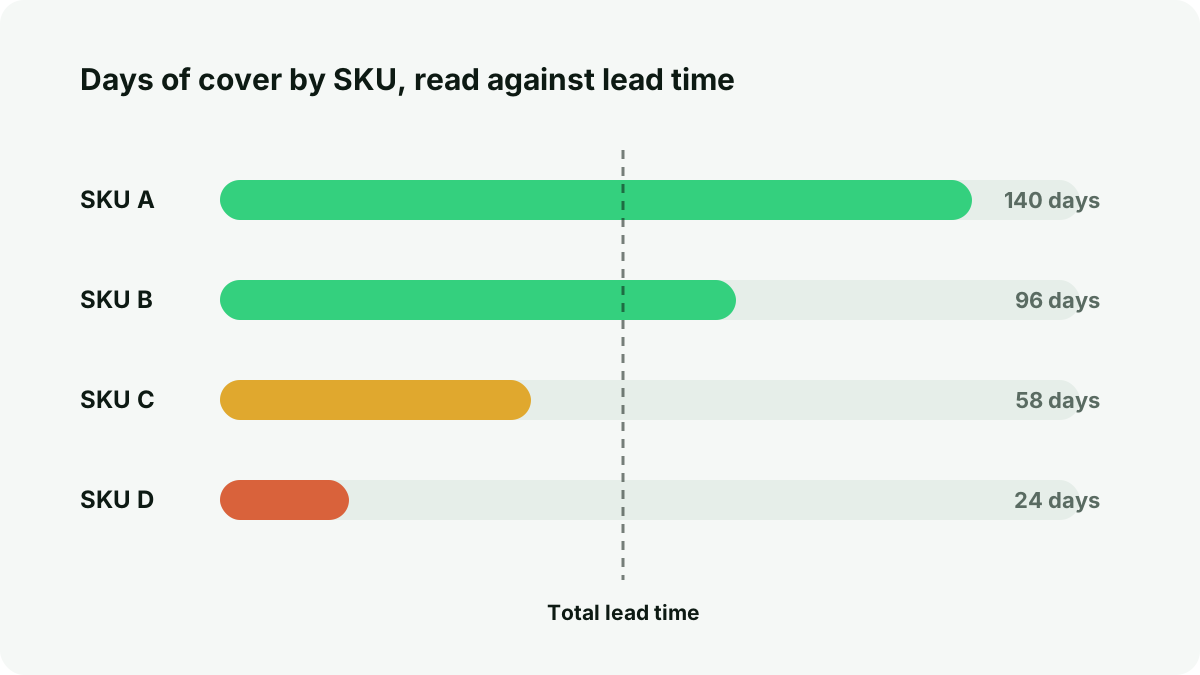
The other half of the calculation is how fast you're selling — and it's easy to get wrong. Look at recent sales, not all-time averages, so the number reflects the product as it is today. And be careful with days when you were out of stock: a day with no stock shows no sales, but that's missing supply, not missing demand. Treat those days as real sales and you'll underestimate how fast the product moves — and stock out again.
Days of cover only means something next to how long a reorder takes. Sixty days of cover is plenty if a reorder lands in thirty. It's an emergency if a reorder takes ninety — and for a product made in China and shipped by sea, production plus transit plus FBA check-in can comfortably run past ninety days.
If your days of cover is shorter than your total lead time, the reorder is already late.
Days of cover is most useful when you don't have to go looking for it. Check it for every SKU at least weekly, and have the products that are drifting toward their lead time flagged for you — rather than finding out when a listing goes out of stock.
Swap one number for another and the whole conversation changes. Instead of "we have 1,200 units", you're saying "we have 41 days, and a reorder takes 75". That's a sentence that tells you exactly what to do next.
ChainPilot runs all five systems for you — forecasting, reordering, cash flow, freight and quality — without the hire.
Join the waitlist